On this page
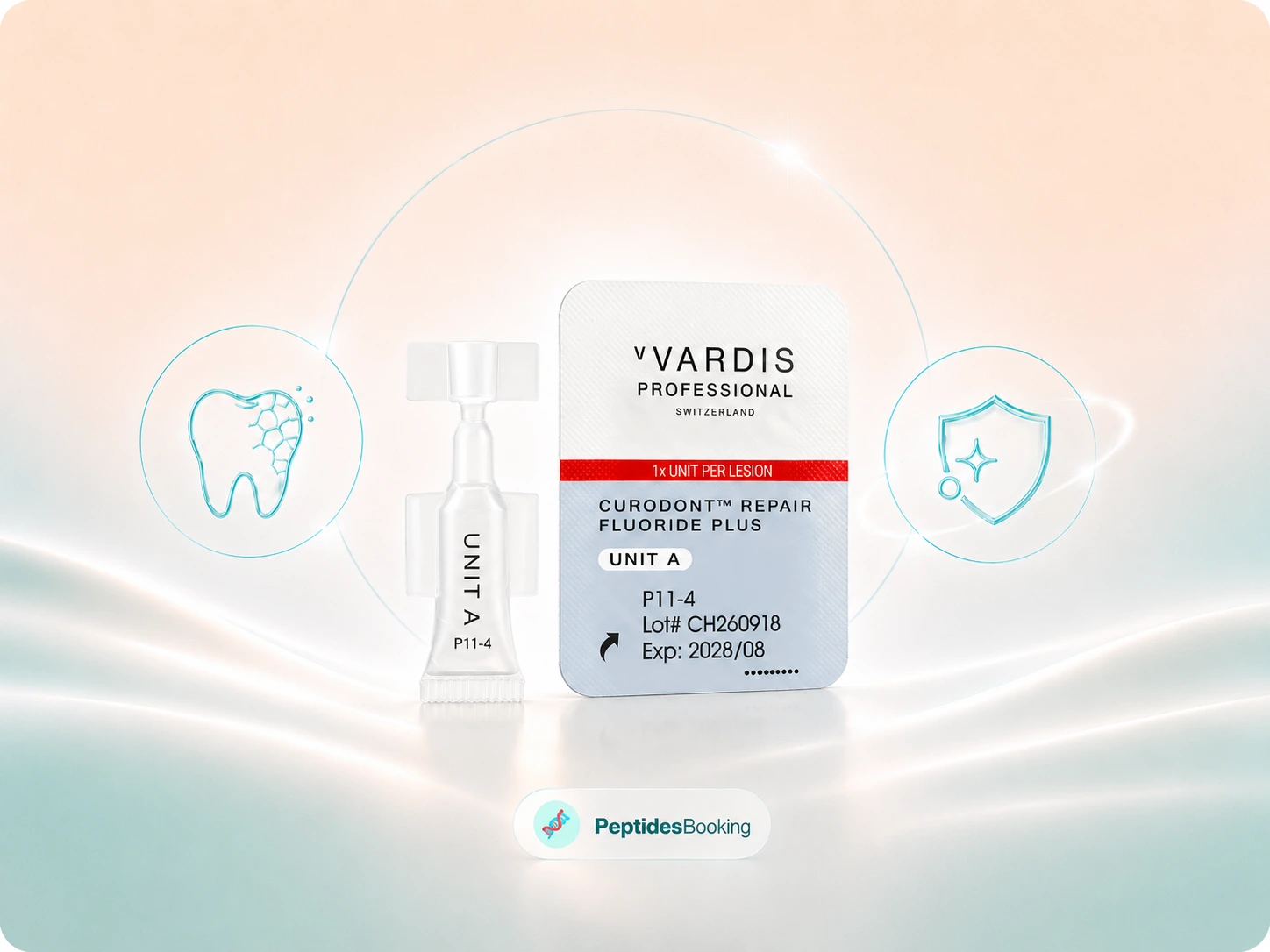
That’s exactly what more patients are experiencing thanks to a synthetic peptide called P11-4. Sold under the brand Curodont Repair (and Curodont Repair Fluoride Plus), this treatment doesn’t remove decayed tooth structure - it helps the tooth rebuild itself.
Social media is lighting up with stories of people who left the chair amazed. But this isn’t hype. It’s backed by multiple clinical trials and a major systematic review. Here’s everything you need to know about the peptide that’s rewriting the rules of modern dentistry.
If you are interested to learn more about P11-4 and where to get it: contact us here.
Quick answer
The quick answer
P11-4 is a self-assembling peptide designed to support remineralization of early, non-cavitated tooth decay.
Instead of removing tooth structure with a drill, P11-4 is applied to an early lesion, where it forms a microscopic scaffold that can support the deposition of calcium and phosphate.
Clinical studies suggest that P11-4 may improve arrest and remineralization of early caries lesions compared with fluoride treatment alone.
But the distinction is important:
P11-4 is intended for early lesions where the tooth surface is still intact. It is not a replacement for a filling once a cavity has physically opened.
Why traditional dentistry is changing
For more than a century, the standard answer to a cavity has been straightforward:
Remove the decayed tooth structure and replace it with a restorative material.
That approach remains necessary for many cavities.
But drilling is irreversible.
Once natural tooth structure is removed, it cannot simply be put back. Restorations may also need replacement over time, which can gradually require increasingly extensive treatment.
Early caries lesions are different.
Before the surface of the tooth has collapsed into a physical cavity, mineral loss may exist beneath an otherwise intact surface.
These early lesions are often visible as white spots.
At this stage, the goal can shift from replacing damaged tooth structure to helping the tooth remineralize.
Fluoride has long been used to support that process.
P11-4 introduces another approach.
The goal is not to fill an early lesion. It is to create conditions that allow mineral to return to the damaged enamel.
How P11-4 actually works
P11-4 is a self-assembling peptide composed of 11 amino acids.
When applied to an appropriate early caries lesion, the peptide is designed to diffuse into the demineralized area.
Once inside the lesion, the molecules self-assemble into a three-dimensional scaffold.
The proposed process is:
- P11-4 penetrates the porous, demineralized enamel.
- The peptide self-assembles into a microscopic scaffold within the lesion.
- Calcium and phosphate ions can associate with that scaffold.
- Mineral deposition can occur within the damaged enamel.
The aim is to support remineralization from within the lesion rather than simply covering the surface.
This mechanism has led to P11-4 being described as a biomimetic approach because it attempts to recreate part of the environment required for mineral formation.
Application is typically brief and can be incorporated into a dental appointment after the lesion has been appropriately assessed and prepared.
What the clinical evidence shows
P11-4 has been evaluated in randomized clinical trials involving early caries lesions.
A 2023 systematic review and meta-analysis published in the Journal of the American Dental Association evaluated six randomized trials. [1]
The analysis reported findings including:
- a higher likelihood of lesion arrest
- reduction in lesion size
- lower risk of progression or cavitation.
The review reported an approximately 82% higher probability of complete lesion arrest and an average reduction in lesion size of approximately 32% in the included evidence. [1]
Randomized studies have also evaluated P11-4 in:
- initial buccal caries lesions [2]
- white-spot lesions associated with orthodontic treatment [3]
- early enamel lesions treated alongside fluoride. [4]
These studies generally support the idea that P11-4 can improve remineralization outcomes when used for appropriately selected early lesions.
The clinically important question is not whether P11-4 can replace every filling. It is whether an early lesion can be treated before a filling becomes necessary.
Who may be a suitable candidate?
P11-4 may be considered when a dentist identifies an early lesion that has not yet developed into a physical cavity.
Potential situations include:
- small non-cavitated caries lesions
- early white-spot lesions
- white spots following orthodontic treatment
- patients seeking a minimally invasive treatment approach
- situations where preserving natural tooth structure is especially desirable.
Correct diagnosis matters.
A white area on a tooth is not automatically an active caries lesion, and lesions can differ in depth, activity and risk of progression.
A dentist should determine whether the lesion is appropriate for remineralization rather than restorative treatment.
When P11-4 is not enough
Once the tooth surface has broken down and a true cavity has formed, remineralization alone may no longer be sufficient.
At that point, damaged or infected tooth structure may need conventional restorative treatment.
This is one reason early dental examination matters.
Detecting a lesion before cavitation creates more options for preserving natural tooth structure.
Why this matters for dentistry
P11-4 fits into a broader movement toward minimally invasive dentistry.
The traditional question was often:
"Where should we drill?"
The newer question is increasingly:
"Can this lesion be stopped or remineralized before drilling becomes necessary?"
That change does not eliminate fillings, crowns or other restorative procedures.
Those treatments remain essential when tooth structure has already been significantly damaged.
But earlier detection creates an opportunity to intervene before that point.
This approach may combine:
- improved oral hygiene
- fluoride
- dietary changes
- caries-risk management
- professional monitoring
- remineralization treatments such as P11-4.
The objective is to preserve healthy tooth structure whenever possible.
The bigger picture
P11-4 represents an interesting shift in dental treatment.
Instead of treating every sign of decay as a mechanical problem requiring removal and replacement, early lesions may sometimes be approached biologically.
That is important because natural enamel is valuable.
Every treatment that can safely preserve it potentially delays or avoids the restorative cycle that can follow the first filling.
P11-4 is therefore not important because it eliminates conventional dentistry.
It is important because it may expand the window in which conventional drilling is unnecessary.
The bottom line
P11-4 is an 11-amino-acid self-assembling peptide being used to support remineralization of early dental caries.
Its proposed mechanism involves forming a microscopic scaffold within demineralized enamel that supports mineral deposition.
Clinical trials and systematic reviews suggest benefits for appropriately selected, non-cavitated lesions.
It may be particularly relevant for:
- early caries
- white-spot lesions
- lesions following orthodontic treatment
- patients seeking minimally invasive treatment.
It is not a replacement for restorative dentistry once a cavity has physically formed.
The most important change is therefore not that dentistry is abandoning the drill.
It is that earlier diagnosis can sometimes provide another option before the drill becomes necessary.
References
-
Keeper JH, et al. Systematic review and meta-analysis on the effect of self-assembling peptide P11-4 on arrest, cavitation, and progression of initial caries lesions. Journal of the American Dental Association. 2023;154(7):580-591.e11.
-
Sedlakova Kondelova P, et al. Efficacy of P11-4 for the treatment of initial buccal caries: a randomized clinical trial. Scientific Reports. 2020;10:20211.
-
Welk A, et al. Effect of self-assembling peptide P11-4 on orthodontic treatment-induced carious lesions. Scientific Reports. 2020;10:6819.
-
Alkilzy M, et al. Self-assembling peptide P11-4 and fluoride for regenerating enamel. Journal of Dental Research. 2018.
-
vVARDIS Professional. Curodont Repair clinical information.
https://professional.vvardis.com