On this page
Retatrutide plus this. Retatrutide plus that.
Add something for faster fat loss, something for energy, something for muscle, something for recovery, then another peptide because somebody on a forum said the combination was "synergistic." That approach misses the point.
Retatrutide already affects GLP-1, GIP and glucagon receptors. It is not a weak metabolic foundation that needs six other compounds to make it work.
If another peptide earns a place beside it, that peptide should solve a specific problem retatrutide is not already solving.
That gives us a much better framework.
Instead of asking: "What is the best retatrutide stack?"
Ask: "What job still needs to be done?"
If you are interested to learn more about Retatrutide and where to get it: contact us here.
Retatrutide already does a lot
Retatrutide is a triple-receptor agonist targeting:
- GLP-1
- GIP
- glucagon
That makes it very different from beginning with a weak metabolic intervention and trying to build an entire system around it.
Retatrutide is already doing substantial work.
So before adding another peptide, ask:
What exactly is missing?
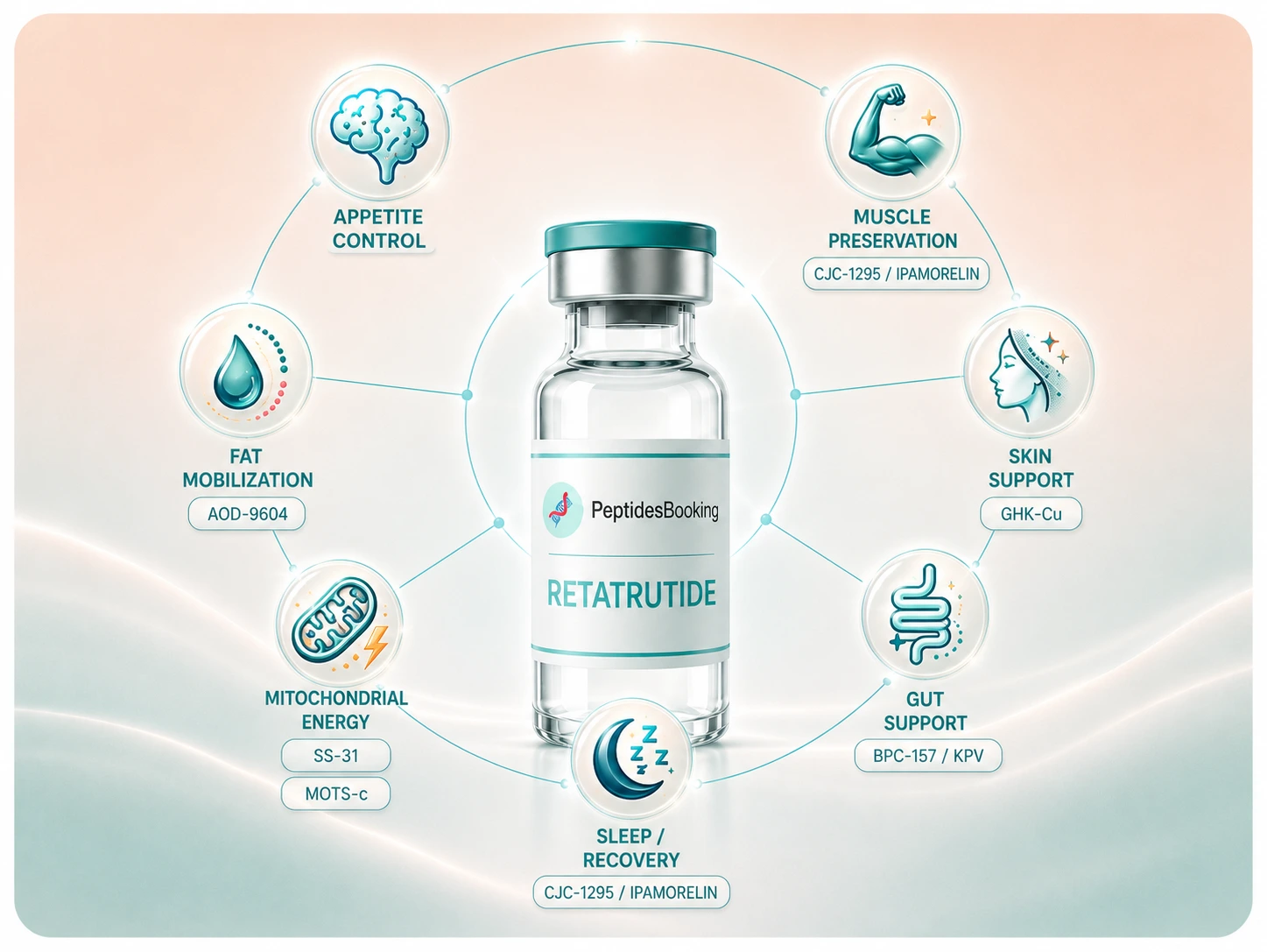
The source transcript divides the answer into four main jobs:
- Appetite control
- Mobilizing stored fat
- Mitochondrial energy handling
- Protecting muscle
There are then several secondary goals involving:
- skin
- gut health
- sleep
- recovery
That is a much more useful way to think about stacking than choosing compounds based on popularity.
Start with the foundation before adding another vial
Before discussing another peptide, the basics still matter.
Major weight loss changes:
- calorie intake
- protein intake
- muscle mass
- training capacity
- hydration
- recovery
If someone is losing weight rapidly while eating very little protein and doing no resistance training, another peptide is unlikely to fix the fundamental problem.
A strong foundation generally includes:
- adequate protein
- resistance training
- sufficient overall nutrition
- sleep
- medical monitoring
- a clear treatment goal
Peptides should add to a functioning plan, not replace one.
This becomes especially important when body composition is the goal.
Losing weight is not automatically the same as improving body composition.
Job one: appetite
Retatrutide can substantially reduce appetite.
But appetite response varies.
Some people may experience very strong appetite suppression.
Others may lose weight effectively while still experiencing:
- evening hunger
- persistent food noise
- cravings
- difficulty maintaining calorie control
The transcript makes an interesting observation.
Some patients reportedly experience stronger weight loss with retatrutide while describing better appetite suppression on tirzepatide.
Those two experiences can theoretically coexist because the drugs do not produce identical receptor activity.
But there is an important limitation.
Retatrutide already targets GLP-1 and GIP.
Tirzepatide targets those same two receptor systems.
So combining them is not simply "adding another pathway."
There is substantial overlap.
Sometimes the answer is not another appetite drug
If appetite is already well controlled, adding another incretin-based medication may solve a problem that does not exist.
Before adding anything, ask:
- Is hunger actually interfering with progress?
- Is food noise still significant?
- Is weight still decreasing?
- Are side effects already limiting treatment?
- Is appetite perhaps suppressed too much?
That last question matters.
More appetite suppression is not always beneficial.
Eating too little can make it harder to maintain:
- protein intake
- micronutrient intake
- muscle
- training
- recovery
Job two: stubborn fat and AOD-9604
AOD-9604 frequently appears in fat-loss peptide discussions.
The source transcript frames AOD-9604 as a tool intended to support the release of stored fat.
That creates an appealing idea:
Retatrutide creates the metabolic environment.
AOD-9604 helps mobilize stubborn stored fat.
But there is a major evidence limitation.
AOD-9604 has been studied in obesity research, but it has not become an established approved obesity therapy.
Claims that it selectively melts stubborn fat should therefore be treated cautiously.
Fat release is not the same as fat loss
This is one of the more useful concepts in the transcript.
Even if a compound increases the availability of stored fat, the body still needs an energetic reason to use it.
The transcript describes this as supply and demand.
Think of stored fat as fuel inside a warehouse.
Opening the warehouse door does not guarantee the fuel gets burned.
There also needs to be demand.
That demand can come from:
- calorie deficit
- physical activity
- training
- metabolic requirements
Do not use another peptide to rescue a broken fat-loss plan
If weight loss has stalled, the first assumption should not automatically be:
I need another peptide.
A plateau may involve:
- reduced calorie needs after weight loss
- less daily movement
- inconsistent intake
- fluid changes
- constipation
- reduced training
- reduced muscle mass
- medication tolerance
- unrealistic expectations
The cause matters.
Adding AOD-9604 or another compound without identifying the reason for the plateau may simply add another variable.
Job three: the mitochondrial engine
Once stored energy becomes available, cells still need to use it.
This is where mitochondrial peptides enter the conversation.
The source discusses:
- SS-31
- MOTS-c
It also mentions SLU-PP-332, although SLU-PP-332 is a small molecule rather than a peptide.
These compounds are discussed because they interact with different parts of cellular energy biology.
But they should not all be treated as interchangeable "energy peptides."
SS-31 and MOTS-c do different jobs
A useful conceptual distinction is:
SS-31 is discussed more as a mitochondrial structural and functional support compound.
MOTS-c is discussed more as a metabolic signaling peptide.
That creates a popular sequencing theory:
First support the machinery.
Then increase the metabolic signal.
Or more simply:
Repair first. Then ask the engine to work harder.
This is a useful biological framework.
It is not the same as a clinically proven universal sequence.
Why mitochondrial therapies may disappoint
People sometimes expect mitochondrial peptides to feel like stimulants.
They may expect:
- immediate energy
- dramatically better workouts
- instant mental clarity
- obvious metabolic changes
That may be the wrong expectation.
Changes in mitochondrial biology may be much less noticeable.
Useful outcomes might instead look like:
- fewer afternoon crashes
- better exercise tolerance
- improved recovery
- more consistent training
- improved metabolic measurements
These are changes that may require tracking over time.
Do not add several mitochondrial compounds at once
This is where stacks become impossible to interpret.
Imagine starting:
- SS-31
- MOTS-c
- SLU-PP-332
- NAD-related therapy
at roughly the same time.
Then energy improves.
Which intervention worked?
Or fatigue gets worse.
Which one caused it?
You cannot answer easily.
A more interpretable approach is:
- Define the problem.
- Establish a baseline.
- Add one meaningful intervention.
- Measure the response.
- Decide whether another intervention is necessary.
More compounds create more possibilities, but also less information.
Job four: muscle preservation
This may be the most important part of the entire retatrutide stack conversation.
Major weight loss does not remove only body fat.
Some lean tissue is usually lost too.
That is true with:
- dieting
- semaglutide
- tirzepatide
- retatrutide
- bariatric surgery
- other substantial weight-loss interventions
Losing some lean mass during large weight reduction is expected.
The goal should be to minimize unnecessary loss.
Why muscle matters after weight loss
Muscle is not just cosmetic.
It contributes to:
- strength
- glucose disposal
- physical function
- metabolic health
- exercise capacity
- long-term independence
A person can reach a lower body weight while also becoming weaker.
That is not necessarily a better metabolic outcome.
What about CJC-1295 and ipamorelin?
CJC-1295 and ipamorelin are commonly discussed as growth-hormone secretagogues.
The general concept is to stimulate the body's own growth-hormone signaling rather than administer growth hormone directly.
They are frequently marketed for:
- recovery
- sleep
- body composition
- muscle preservation
- fat loss
But controlled human evidence supporting many of these optimization claims remains limited.
They should therefore not be presented as proven muscle-preservation treatments for people using retatrutide.
What about tesamorelin?
Tesamorelin is different because there is an FDA-approved tesamorelin drug.
Its approved use is highly specific.
Tesamorelin is used to reduce excess abdominal fat in adults with HIV and lipodystrophy.
It is not generally approved as a weight-loss or bodybuilding medication.
That distinction matters.
Tesamorelin can influence:
- growth-hormone signaling
- IGF-1
- visceral fat
- glucose metabolism
Glucose tolerance therefore deserves attention.
Muscle preservation is a long-term strategy
The transcript makes an important argument:
The real goal is not simply losing weight.
It is arriving at the lower weight with enough metabolic and physical capacity to maintain the result.
That means protecting:
- muscle
- strength
- nutritional habits
- training capacity
- metabolic health
may matter more for long-term success than adding another compound that produces slightly faster weight loss.
Secondary goal: skin changes during rapid weight loss
Large weight loss can change the appearance of:
- facial skin
- abdominal skin
- connective tissue
- hair
This is one reason GHK-Cu frequently appears in weight-loss peptide discussions.
GHK-Cu is a copper-binding peptide studied in relation to:
- skin biology
- collagen
- wound healing
- tissue remodeling
- hair
Topical GHK-Cu also has a much longer history in cosmetic formulations than injectable use.
GHK-Cu will not replace the effects of time
When someone loses substantial weight quickly, skin may continue changing for months afterward.
Factors include:
- age
- genetics
- amount of weight lost
- duration of prior obesity
- sun exposure
- smoking
- nutrition
- time
A skin peptide may be an interesting adjunct.
It is not a guarantee that loose skin will disappear.
Secondary goal: gut health
The transcript also mentions BPC-157 and KPV for gastrointestinal symptoms.
These compounds are popular in peptide communities because they are associated with:
- tissue repair research
- inflammatory signaling
- gastrointestinal biology
But human clinical evidence for many retail gut-health claims remains limited.
That distinction is especially important because GLP-1 related therapies can themselves produce gastrointestinal symptoms.
These can include:
- nausea
- constipation
- reflux
- prolonged fullness
- bloating
A new gut symptom should not automatically lead to another peptide.
Secondary goal: sleep and recovery
People often underestimate how important sleep becomes during major weight loss.
Poor sleep can influence:
- hunger
- recovery
- glucose regulation
- training quality
- energy
- mood
Some growth-hormone secretagogue users report changes in sleep and recovery.
But those effects should not distract from common causes of poor sleep.
These include:
- sleep apnea
- reflux
- caffeine
- stress
- medication side effects
- inadequate nutrition
- irregular sleep schedules
A peptide should not be used to avoid diagnosing the actual problem.
The wrong way to build a retatrutide stack
The wrong strategy looks something like this:
Retatrutide for weight.
Tirzepatide for appetite.
AOD-9604 for fat.
SS-31 for mitochondria.
MOTS-c for energy.
CJC-1295 and ipamorelin for muscle.
GHK-Cu for skin.
BPC-157 and KPV for the gut.
Suddenly one treatment has become eight.
At that point, the problem is no longer finding a peptide.
The problem is understanding what any of them are doing.
Use the four-job framework instead
Before adding anything beside retatrutide, ask which job actually needs help.
Appetite
Is food noise still interfering with treatment?
Fat loss
Is there a true plateau, or has the energy balance changed?
Mitochondrial function
Is low energy actually the problem, and have more common causes been evaluated?
Muscle
Are strength, protein intake and resistance training being protected?
Then consider secondary goals such as:
- skin
- gut symptoms
- sleep
- recovery
This creates a roadmap.
Not a shopping list.
One change at a time is usually easier to understand
Whenever possible, avoid introducing several interventions simultaneously.
Why?
Because every treatment should answer a question.
If you add one intervention and something improves, you learn something.
If you add five interventions and something improves, you mostly learn that one of five things may have helped.
The same principle applies to adverse effects.
If sleep worsens after adding four compounds, identifying the cause becomes difficult.
What a good clinic should do before recommending a stack
A clinic should not simply ask:
"What peptides are you interested in?"
A better consultation should ask:
- What is your primary goal?
- How much weight have you already lost?
- Is appetite actually a problem?
- Are you losing strength?
- Are you resistance training?
- Is protein intake adequate?
- Are you experiencing fatigue?
- Are you sleeping well?
- Are you experiencing gastrointestinal side effects?
- What medications and peptides are already being used?
- What outcome are we trying to improve next?
The stack should follow the clinical problem.
Not the other way around.
Questions to ask before booking a peptide clinic
The maintenance question matters more than the stack
The source transcript makes one larger argument that is worth keeping.
The goal should not simply be to lose as much weight as possible as quickly as possible.
The harder problem is maintaining the result.
That means asking:
- Is appetite manageable?
- Is muscle being protected?
- Is training sustainable?
- Is nutrition adequate?
- Are metabolic improvements being maintained?
- Can treatment eventually become less intensive?
Those questions matter more than whether another compound produces an extra few weeks of faster loss.
Retatrutide itself remains investigational
This is particularly important when discussing stacks.
Retatrutide is still an investigational drug.
That means combinations involving retatrutide are even less established than combinations built around already approved metabolic medications.
Many of the other compounds discussed in peptide stacking are themselves:
- experimental
- unapproved for the proposed use
- supported mainly by preclinical evidence
- used off-label
- or lacking robust combination studies
The bottom line
References
-
Doctor Explains the BEST Peptides to Stack with Retatrutide. YT-Video.
-
The four-job framework involving appetite, fat mobilization, mitochondrial function and muscle preservation is derived from the source transcript.
-
The sequencing concepts involving SS-31, MOTS-c, AOD-9604, growth-hormone secretagogues, GHK-Cu, BPC-157 and KPV reflect the source author's clinical and mechanistic framework. Several of these uses remain experimental and should not be interpreted as established combination protocols.