On this page
It is about how the molecule is classified under U.S. law.
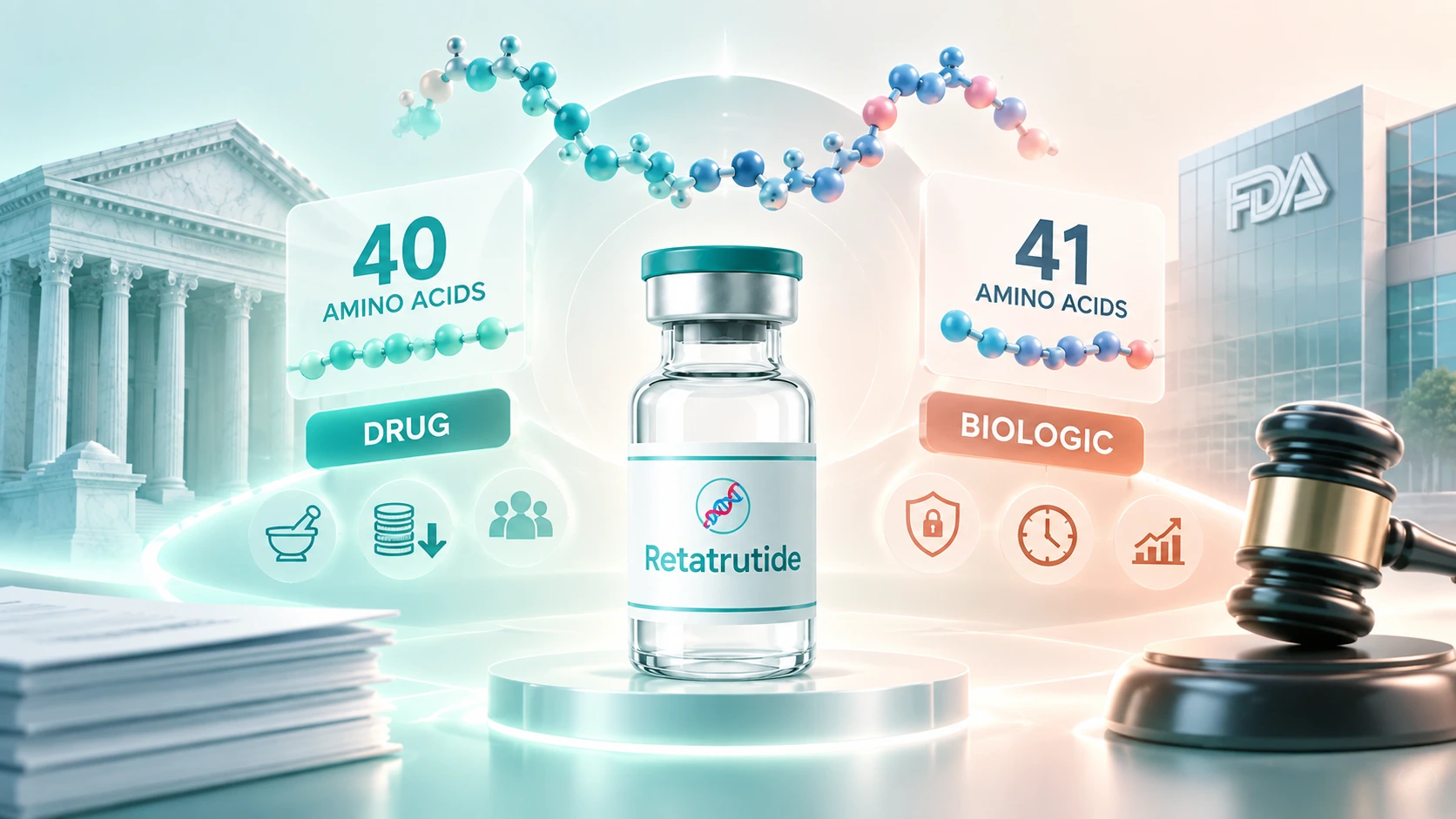
Eli Lilly and the FDA disagree over whether retatrutide should be regulated as a conventional drug or as a biological product.
At the center of the dispute is a surprisingly technical question involving its amino acids.
But the consequences are not technical at all.
The answer could influence the regulatory pathway retatrutide follows, how future competitors reach the market, whether ordinary drug-compounding exemptions could ever apply after approval and how long it takes before the product becomes eligible for Medicare price negotiation.
For consumers, this does not mean retatrutide is suddenly available.
It is still investigational.
But the legal fight could help determine what the retatrutide market looks like once an approved product finally arrives.
If you are interested to learn more about Retatrutide and where to get it: contact us here.
Retatrutide is not approved yet
This is the first point to keep clear.
Retatrutide has produced major results in late-stage obesity trials, but it remains an investigational medication.
It is a triple agonist targeting:
- GLP-1 receptors
- GIP receptors
- glucagon receptors
Its Phase 3 development program has produced substantial weight-loss results and data across obesity-related conditions.
Lilly has said it plans to submit retatrutide for U.S. approval in the first quarter of 2027.
But a planned submission is not an approval.
Until regulators review the application and make a decision, retatrutide remains investigational.
So why is retatrutide already in federal court?
Because Lilly and the FDA disagree over what kind of regulated product retatrutide is.
In 2023, Lilly asked FDA to classify retatrutide as a biological product.
FDA disagreed.
In March 2024, the agency classified retatrutide as a drug rather than a biologic.
Lilly challenged that decision in federal court.
The dispute eventually reached the U.S. Court of Appeals for the Seventh Circuit.
This is not a lawsuit about whether retatrutide works.
It is not primarily about whether the drug is safe.
It is about which regulatory framework should apply.
The strange part: it comes down to amino acids
FDA regulations contain a definition of a protein that uses an amino-acid threshold.
A protein is defined, in relevant part, as an alpha amino acid polymer with a specific defined sequence that is greater than 40 amino acids in size.
Retatrutide sits right around that boundary.
Lilly describes retatrutide as containing 41 amino acids in total.
Its structure includes:
- a backbone of 39 alpha amino acids
- an attached gamma-glutamate residue
- an additional component called ADO
The argument is not simply whether someone can count to 41.
The real question is:
Which parts count toward FDA's legal definition of a protein?
Lilly and FDA read the rule differently
Lilly's position is essentially that the relevant size calculation should consider the total amino acids in the associated chains.
On that interpretation, retatrutide clears the threshold.
FDA interprets the rule differently.
The agency's position is that the protein definition requires more than 40 alpha amino acids.
Under FDA's analysis, retatrutide has no more than 40 alpha amino acids.
That leaves it on the drug side of the regulatory line rather than clearly inside the protein definition.
It is an unusually technical distinction with unusually large commercial consequences.
One regulatory definition could influence years of competition and access.
What did the first federal court decide?
The district court did not simply declare one side completely correct.
The result was split.
On the first question, whether retatrutide itself satisfies the regulatory definition of a protein, the court sided with FDA.
The court concluded that the regulation requires at least 41 alpha amino acids.
Retatrutide did not meet that requirement under the court's interpretation.
But that was not the end of the case.
There is another route in federal law.
A biological product can also include something considered "analogous" to a protein.
FDA had concluded that retatrutide was not analogous to a protein either.
The court rejected the reasoning FDA used for that part of the decision.
It vacated that portion and sent the question back to the agency for reconsideration.
Where the case stands now
Lilly appealed.
The case is now before the U.S. Court of Appeals for the Seventh Circuit.
Oral argument took place on September 24, 2026.
As of this article's publication, the appeals court has not issued a final merits ruling.
That means the classification question remains unresolved.
Meanwhile, Lilly has publicly said it plans to submit a Biologics License Application for retatrutide in the first quarter of 2027.
That makes this more than an academic debate.
The company is actively preparing for the regulatory path it believes should apply.
Why should a patient care whether it is called a drug or biologic?
Because the classification affects what happens around the medication after approval.
The molecule itself does not suddenly become stronger or weaker.
The clinical trial data do not change.
But the legal framework surrounding the product can change substantially.
That can influence:
- what type of application is used
- how competitors enter the market
- how long certain exclusivity periods last
- whether biosimilar competition is possible
- whether ordinary drug compounding exemptions apply
- when Medicare negotiation may become available
For consumers, those differences can eventually translate into questions about:
- access
- price
- supply
- competition
The compounding issue is especially important
This is one reason the case has attracted so much attention in the peptide and compounding world.
Sections 503A and 503B of federal drug law create limited exemptions that can allow qualifying compounded drugs to be prepared under specific circumstances.
Biological products are different.
FDA states that biologics are not eligible for the compounded-drug exemptions under sections 503A and 503B.
So if retatrutide is ultimately licensed as a biologic, the ordinary drug-compounding route would not simply open during a shortage.
"But I see compounded retatrutide advertised online"
This is where consumers need to be particularly careful.
A website using words such as:
- compounded
- research
- pharmacy grade
- clinical grade
- tested
- physician supervised
does not automatically establish that the product is lawfully marketed.
FDA has specifically taken enforcement action against companies selling products labeled as retatrutide.
The agency's position is clear:
Retatrutide cannot currently be used in compounding under federal law.
That is very different from approved GLP-1 medications that may, under specific statutory circumstances, have lawful compounding pathways.
"Research use only" does not automatically solve the problem
Another common workaround is labeling a vial:
"For research use only. Not for human consumption."
But regulators look at more than a disclaimer.
If the surrounding marketing clearly promotes the product for:
- weight loss
- appetite suppression
- injection
- metabolic treatment
- body composition
the intended use can matter.
FDA has issued warning letters involving peptide sellers marketing supposedly research-only products in ways suggesting human use.
Lilly has also sued companies selling retatrutide
In August 2026, Lilly filed six lawsuits against U.S. companies that it alleges were unlawfully selling products represented as retatrutide.
The defendants included different types of businesses in the peptide, medical spa and compounding market.
That litigation should be separated from the FDA classification case.
They are related to the same molecule, but they address different questions.
The seller cases focus on products being marketed now while retatrutide remains unapproved.
The FDA case focuses on which regulatory category retatrutide should occupy.
These are two different legal stories
Think of it this way.
Story one: today's retatrutide market
Retatrutide remains investigational.
FDA says it cannot currently be used in compounding.
Companies are nevertheless selling products labeled retatrutide.
FDA and Lilly have taken action against some sellers.
Story two: the future approved market
If retatrutide receives approval, will it be regulated as:
- a drug
- or a biologic?
That decision affects the regulatory structure around the future approved product.
Mixing those two stories together creates confusion.
Does biologic status mean a longer monopoly?
Not exactly.
The word "monopoly" oversimplifies the system.
Regulatory exclusivity, patents and market competition are separate concepts.
But the classification can affect the exclusivity framework.
For an eligible biological reference product, federal law can prevent FDA from making biosimilar approval effective until 12 years after first licensure.
A qualifying conventional new drug can operate under a different exclusivity framework, including five-year new chemical entity exclusivity when the statutory requirements are met.
Those are not guaranteed periods of total market exclusivity.
Patents, litigation, additional exclusivities and competitor development can all affect what happens in practice.
What is a biosimilar?
If retatrutide becomes a biologic, future competition would potentially involve the biosimilar pathway rather than the conventional generic-drug pathway.
A biosimilar is a biological product that is highly similar to an already approved reference biologic and has no clinically meaningful differences in safety, purity and potency.
Biologics are structurally more complex than conventional small-molecule drugs.
That is why the regulatory system treats biosimilars differently from conventional generics.
For consumers, however, the practical issue is straightforward:
Competition generally matters for price and access.
Could this affect Medicare negotiation too?
Yes.
Under the current Medicare Drug Price Negotiation Program, the waiting period before a qualifying single-source product can become eligible for selection differs depending on the approval pathway.
For a drug approved under a New Drug Application, the relevant period is at least seven years after approval.
For a biological product licensed under a Biologics License Application, it is at least eleven years.
That is a four-year difference.
It does not tell us what retatrutide will eventually cost.
It does not guarantee that Medicare will select the product.
But classification can influence when the product could first become eligible under the program.
Does this court fight prove pharmaceutical corruption?
No.
That conclusion goes beyond what the legal record establishes.
A pharmaceutical company seeking the regulatory classification that it believes applies to its product is not itself evidence of corruption.
Lilly has obvious commercial interests.
So do competitors, compounders and other parties affected by the classification.
That is normal in regulatory litigation.
The useful consumer question is not:
"Who is the villain?"
It is:
"What does each legal outcome actually change for patients?"
That keeps the discussion focused on facts rather than motives we cannot prove.
Lilly also has a legitimate development argument
Retatrutide did not appear out of nowhere.
Large clinical development programs require substantial investment.
They involve:
- preclinical development
- manufacturing
- toxicology
- Phase 1 studies
- Phase 2 studies
- large Phase 3 trials
- regulatory submissions
- manufacturing scale-up
- post-approval commitments
Companies use patents and regulatory exclusivity to protect investments like these.
The policy question is how those incentives should be balanced against:
- competition
- affordability
- access
- public spending
The current lawsuit operates inside rules Congress and FDA already created.
But biologic classification could still matter to affordability
Recognizing the cost of drug development does not make the downstream access question disappear.
If biologic classification leads to:
- a different competition pathway
- longer reference-product exclusivity
- no ordinary 503A or 503B compounding route
- a longer Medicare negotiation waiting period
then consumers have a legitimate reason to pay attention.
The case can matter financially without requiring a theory of misconduct.
What the case does not decide
This legal battle does not decide whether:
- retatrutide is effective
- retatrutide is safe for you
- you qualify for future treatment
- retatrutide will be approved
- insurance will cover it
- the launch price will be affordable
- a cheaper competitor will quickly appear
Those are separate questions.
The clinical evidence and the regulatory classification should not be confused.
Drug versus biologic is a legal classification question, not a verdict on whether retatrutide works.
What should someone interested in retatrutide do today?
The simplest answer is:
Do not build an entire metabolic plan around a medication that has not yet received routine market approval.
Retatrutide may eventually become an important option.
But approved treatments already exist.
Depending on the patient and indication, those can include established metabolic medications such as semaglutide and tirzepatide.
A responsible clinician can evaluate:
- current body weight
- metabolic health
- diabetes status
- cardiovascular risk
- previous treatments
- appetite
- side effects
- muscle preservation
- nutrition
- long-term maintenance
Waiting for the next molecule should not mean ignoring treatment options available now.
Be skeptical of clinics promising retatrutide access today
This is especially relevant for people searching peptide clinics.
A clinic or website may use phrases such as:
- "retatrutide program"
- "GLP-3"
- "triple agonist therapy"
- "research retatrutide"
- "compounded retatrutide"
Those labels deserve questions.
If a provider claims to offer retatrutide now, ask exactly what product is being supplied and under what legal authority.
Do not assume:
"prescribed by a clinic"
automatically means:
"FDA-approved or lawfully compounded."
What to ask a clinic about retatrutide
Before paying for any program involving retatrutide, ask:
-
Is this an FDA-approved retatrutide product?
-
If not, what exactly is being supplied?
-
Under what legal pathway is it being provided?
-
Is this part of an authorized clinical trial or another authorized access program?
-
Who manufactured the product?
-
How are identity, concentration, sterility and quality verified?
-
What evidence supports the treatment being offered?
-
What approved alternatives should I consider today?
-
Who manages side effects and follow-up?
-
What happens if retatrutide's regulatory status changes?
A legitimate medical provider should be comfortable answering those questions.
Why the future compounding question still matters
Even though retatrutide cannot currently be compounded, the classification fight still matters for future policy.
Imagine retatrutide receives approval and demand becomes enormous.
If the product were treated as a conventional drug, drug-compounding rules could become relevant under certain limited future circumstances.
If it is licensed as a biologic, FDA states that the 503A and 503B drug-compounding exemptions do not apply to biological products.
That difference could become particularly important during:
- shortages
- supply constraints
- periods of very high demand
But even for conventional approved drugs, compounding is not simply an unrestricted cheaper-copy pathway.
Federal law places significant limitations on essentially copying commercially available approved products.
A shortage would not automatically make everything legal
This is another area where GLP-1 history has created unrealistic expectations.
People saw compounded semaglutide and tirzepatide become widely available during shortage periods.
That does not mean every future obesity drug will follow the same path.
Different molecules can fall under different laws.
Different classifications can create different rules.
And regulatory policy continues to evolve.
What happens next?
There are several things worth watching.
First, the Seventh Circuit can issue its decision in the Lilly appeal.
Second, FDA still has the separate "analogous to a protein" issue created by the district court's remand.
Third, Lilly plans to submit a Biologics License Application in the first quarter of 2027.
Then comes the regulatory review itself.
Only after approval would questions such as:
- commercial launch
- list price
- insurance coverage
- supply
- real-world access
begin to become clearer.
The bottom line
References
-
Source transcript: Retatrutide regulatory classification and access update. YT-Video.
-
Eli Lilly and Company v. Kennedy. U.S. District Court for the Southern District of Indiana. Order on Cross-Motions for Summary Judgment and Amended Order. 2025.
-
Eli Lilly and Company v. Robert Kennedy, Jr., et al. U.S. Court of Appeals for the Seventh Circuit. No. 26-1301. Oral argument held September 24, 2026.
-
U.S. Food and Drug Administration. FDA's Concerns With Unapproved GLP-1 Drugs Used for Weight Loss. 2026.
-
U.S. Food and Drug Administration. Compounding and the FDA: Questions and Answers.
-
U.S. Food and Drug Administration. Purple Book and Reference Product Exclusivity information.
-
Centers for Medicare & Medicaid Services. Medicare Drug Price Negotiation Program guidance.
-
Eli Lilly and Company. Retatrutide Phase 3 TRIUMPH-2 and TRIUMPH-3 results and planned Q1 2027 Biologics License Application. July 2026.
-
Eli Lilly and Company. Legal actions concerning unauthorized retatrutide sales. August 2026.