On this page
Instead, a few weeks later, your stomach feels heavier.
You are eating less, but you feel more bloated. You get full faster, but digestion feels slower. Constipation may appear. Foods that never bothered you suddenly seem harder to tolerate.
So what is going on?
With retatrutide, the answer is more complicated than "good for the gut" or "bad for the gut."
Retatrutide was designed as a metabolic drug, not as a treatment for intestinal permeability. But because it affects appetite, digestion and metabolic signaling, it can change the environment inside your gastrointestinal system.
Sometimes that feels better.
Sometimes it feels worse.
And sometimes the change tells us much less than social media would have you believe.
If you are interested to learn more about Retatrutide and where to get it: contact us here.
Quick answer
The quick answer
Retatrutide is not a direct treatment for "leaky gut."
It was designed as a metabolic drug that targets GIP, GLP-1 and glucagon receptors.
But those pathways can change appetite, digestion, food intake and gastrointestinal motility.
That means some people may notice:
- more fullness
- slower digestion
- constipation
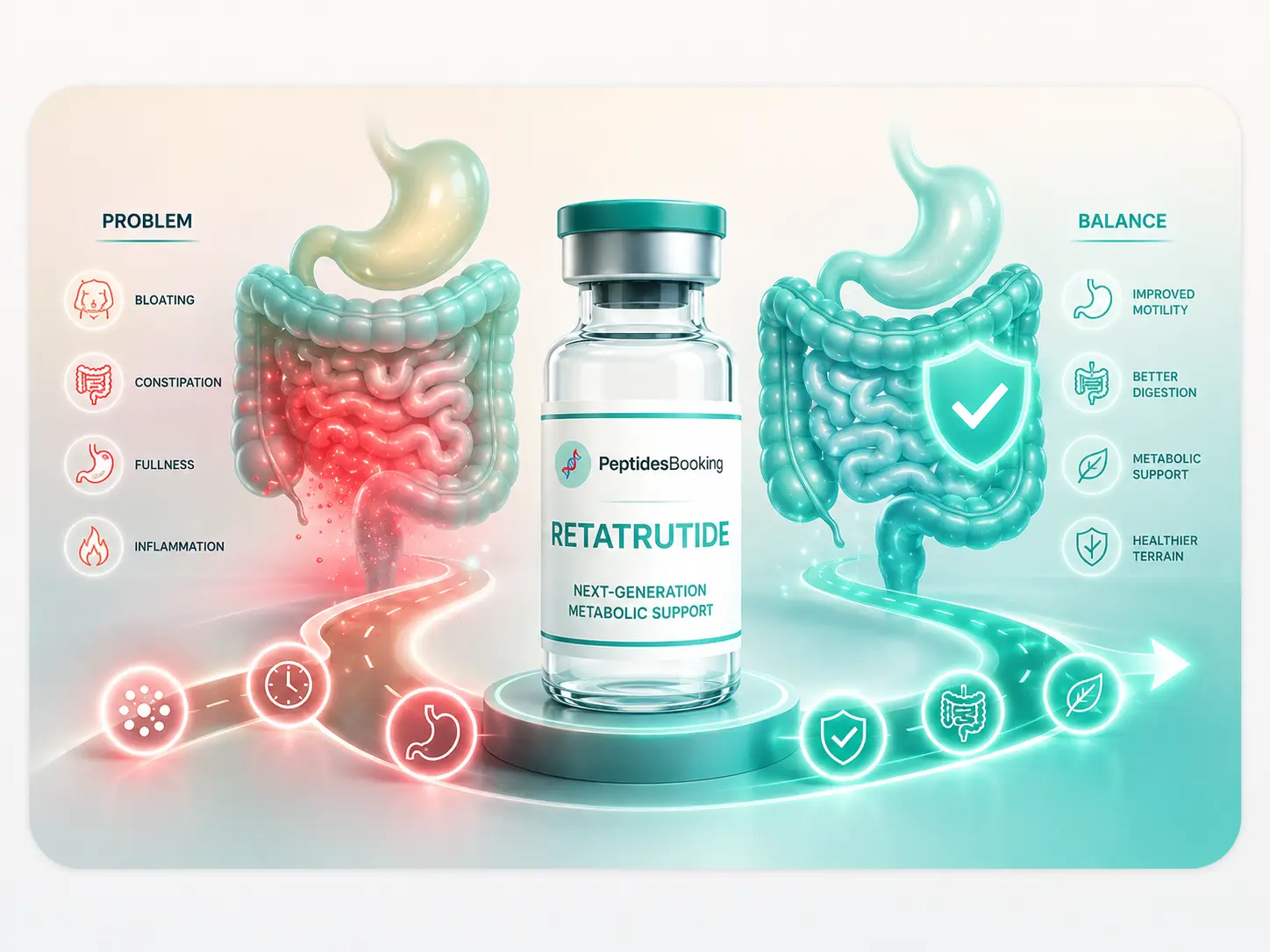
- bloating
- nausea
- changes in bowel habits
These symptoms do not automatically mean retatrutide is damaging the gut.
They also do not prove that retatrutide is healing the intestinal barrier.
The more useful question is:
What changed after treatment started, and what is actually causing the symptom?
What does "leaky gut" actually mean?
The phrase "leaky gut" is used so broadly online that it can mean almost anything.
Some people describe it as the hidden cause of fatigue, weight gain, inflammation, brain fog and autoimmune disease.
Others dismiss the entire idea.
The more useful concept is intestinal permeability.
The intestinal lining acts as a selective barrier between the contents of your digestive tract and the rest of your body.
It needs to allow certain things through, including nutrients, water and electrolytes.
At the same time, it helps limit the movement of microbes and unwanted substances across the intestinal wall.
The cells lining the intestine are connected by structures called tight junctions.
These junctions can be influenced by factors such as:
- inflammation
- infection
- immune activity
- medications
- diet
- gastrointestinal disease
So intestinal permeability is real biology.
But bloating, fatigue or food sensitivity alone do not prove that someone has a damaged intestinal barrier.
Retatrutide does not directly repair the gut wall
This is one of the most important distinctions in the entire conversation.
Retatrutide targets:
- GIP
- GLP-1
- glucagon
It does not target GLP-2.
GLP-2 biology is more directly associated with the intestinal lining, mucosal growth and barrier function.
That means retatrutide should not be described as a peptide that directly rebuilds the intestinal wall.
Its primary effects are metabolic.
If someone's digestive symptoms change while using a metabolic treatment, there may still be a gut connection.
But the connection is more likely to involve changes in digestion, motility, food intake and the wider metabolic environment.
Why your digestion can feel slower
One of the major effects associated with GLP-1 related signaling is slower gastrointestinal movement.
This can help explain why people often feel full after eating much less food.
A smaller meal may feel more satisfying.
Hunger may decrease.
Food may remain in the stomach longer.
For weight management, those effects can be useful.
For digestion, they can also be uncomfortable.
Slower movement may contribute to:
- prolonged fullness
- constipation
- nausea
- reflux
- abdominal pressure
- bloating
So the same biological effect can create both a benefit and an unwanted symptom.
Why slower digestion can mean more bloating
Your digestive tract contains a large population of microorganisms.
Some of those organisms ferment food components.
Fermentation produces gas.
When digestive contents move more slowly, bacteria may have more time to interact with what you eat.
For someone already prone to constipation, gas or fermentation-related symptoms, slower motility may make those symptoms more noticeable.
This does not necessarily mean the medication created the original problem.
It may simply have changed the digestive environment enough for the symptom to become easier to notice.
Think of it as changing the speed of traffic.
The road may already have had problems.
Slowing everything down can make those problems more obvious.
The same treatment can feel very different from person to person
One person may experience mild constipation.
Another may become very bloated.
Another may struggle with nausea.
Another may barely notice a digestive change.
Why?
Because the medication is only one part of the equation.
Other factors include:
- baseline bowel habits
- meal size
- food choices
- hydration
- fiber intake
- existing gastrointestinal conditions
- other medications
- supplements
- activity level
- dose changes
This is why copying another person's experience is rarely useful.
The same medication can interact with very different digestive systems.
Feeling worse does not automatically mean the treatment is working
Another common mistake is turning every uncomfortable symptom into evidence of healing.
The bloating means your gut is repairing.
The fatigue means your body is detoxing.
The headache means inflammation is leaving.
This type of reasoning makes treatment almost impossible to evaluate.
If feeling better means the treatment works and feeling worse also means the treatment works, there is no result that could ever challenge the theory.
A better approach is to take new symptoms seriously.
Ask:
- When did the symptom begin?
- Did it appear after a dose change?
- Is it improving or getting worse?
- Has bowel frequency changed?
- Are you eating substantially less?
- Are you drinking enough?
- Did the symptom exist before treatment?
- Did you start other supplements or medications?
- Is the symptom mild or interfering with daily life?
The goal should not be to explain the symptom away.
The goal should be to understand it.
Metabolism and gut health are connected
Retatrutide may not directly repair the intestinal barrier, but metabolic health and gut health do influence one another.
Excess body fat, insulin resistance, glucose regulation and inflammatory signaling can interact.
Improving metabolic health may also improve parts of the biological environment in which the gut is functioning.
That could include changes in:
- insulin sensitivity
- glucose control
- liver fat
- body weight
- inflammatory signaling
- food intake
This is where the idea becomes more interesting.
A treatment does not need to directly repair the intestinal wall in order to influence conditions surrounding it.
But this still does not mean:
Retatrutide heals leaky gut.
A more accurate description is:
Retatrutide may change the metabolic environment while also changing digestion.
Those two effects can happen at the same time.
Think about the environment, not just the gut wall
Imagine trying to repair a wall while the room around it is still full of smoke, heat and water damage.
Fixing the environment may make repair easier.
But fixing the environment is not the same as rebuilding the wall itself.
That is a useful way to think about metabolic health and gastrointestinal health.
Important factors may include:
- excess body weight
- poor glucose regulation
- inflammation
- inadequate nutrition
- poor sleep
- stress
- medications
- gastrointestinal disease
Sometimes improving one of those factors improves digestive symptoms.
Sometimes it does not.
The important point is that gut symptoms rarely exist in complete isolation.
Why fiber helps some people and makes others feel worse
Fiber is a perfect example of why one-size-fits-all gut advice often fails.
Someone with constipation may increase the right type of fiber and feel much better.
Someone else may increase fermentable fiber and become dramatically more bloated.
Both experiences can be real.
Fiber can:
- hold water
- add stool bulk
- influence bowel movement
- feed intestinal bacteria
- increase fermentation
Whether that helps depends on what is actually causing the symptom.
If slowed transit is the main issue, some forms of fiber may help.
If fermentation and gas are already major problems, adding more fermentable material may make symptoms more noticeable.
The same symptom can have more than one cause.
Bloating is a symptom, not a diagnosis
Two people can both say:
"My stomach feels swollen."
But they may have completely different problems.
One may primarily have constipation.
Another may primarily have gas and fermentation.
Another may have a food intolerance.
Another may have reflux.
Another may have a gastrointestinal disorder requiring medical evaluation.
This is why treating the word "bloating" is not enough.
A good clinician should be asking what is underneath the symptom.
Where do BPC-157 and KPV fit?
People researching peptides for gut health will quickly encounter BPC-157 and KPV.
They are often discussed together because their proposed roles sound complementary.
BPC-157 is commonly associated with:
- tissue repair
- gastrointestinal research
- healing pathways
KPV is commonly associated with:
- inflammatory signaling
- immune regulation
- gastrointestinal research
That creates an attractive idea:
Support repair while reducing inflammation.
But an attractive mechanism is not the same as strong clinical evidence.
Controlled human evidence for many of the gut claims made around these peptides remains limited.
They should not be presented as guaranteed treatments for:
- IBS
- intestinal permeability
- food intolerance
- inflammatory bowel disease
- bloating
- chronic digestive symptoms
The right question is not:
Does this peptide have an interesting mechanism?
The better question is:
Has this exact use been demonstrated in people?
More peptides do not automatically mean better results
It is easy to build an impressive sounding gut protocol.
Retatrutide for metabolic health.
BPC-157 for repair.
KPV for inflammation.
Larazotide for tight junctions.
Supplements for the microbiome.
Fiber.
Probiotics.
Diet changes.
Now eight variables have changed at once.
That creates a new problem.
If you improve, what actually worked?
If you feel worse, what caused it?
If nothing changes, what should be removed?
Complexity can make a protocol feel sophisticated while making the result harder to understand.
A simpler strategy is often more useful.
Use a sequence instead of a stack
Before adding another treatment, ask:
- What problem are we trying to solve?
- What is the most likely cause?
- What intervention targets that cause?
- How will we know if it worked?
- How long should we evaluate it?
- What would make us stop or change direction?
That creates a roadmap.
It also makes it easier to understand what your body is responding to.
A large stack can hide that information.
What about larazotide?
Larazotide is interesting because its research is more directly connected with tight-junction regulation and intestinal permeability.
That makes it conceptually different from retatrutide.
Retatrutide primarily acts through metabolic hormone receptors.
Larazotide has been investigated around pathways connected more directly with the intestinal barrier.
That does not mean larazotide is a proven universal treatment for "leaky gut."
It means its mechanism is more directly related to the question.
Consumers should still separate:
- interesting biology
- early clinical research
- established treatment
- retail marketing claims
Those categories are not interchangeable.
What about low-dose naltrexone?
Low-dose naltrexone, often called LDN, also appears in some gut and inflammation protocols.
It is important to know that naltrexone is a prescription medication.
It is not a peptide.
At lower doses, it is sometimes used off-label in discussions involving inflammation, chronic pain and neuroimmune signaling.
This highlights a broader point.
A clinic may offer a mixture of:
- approved medicines
- off-label medicines
- compounded products
- peptides
- supplements
- lifestyle interventions
Do not let the word "protocol" hide those differences.
Ask about every component separately.
Low dose does not automatically mean low risk
"Low dose" sounds reassuring.
But it is only a description of quantity.
Safety depends on much more than dose.
It also depends on:
- the drug
- your health
- other medications
- duration of use
- route of administration
- product quality
- the condition being treated
- the evidence supporting that use
A smaller dose may reduce some adverse effects.
It does not automatically make an experimental use proven or risk-free.
Retatrutide is still an experimental treatment
Retatrutide is being developed as a metabolic medicine.
It has produced major clinical-trial results, but it is not currently an FDA-approved commercial retatrutide product.
That distinction matters when browsing clinics or online sellers.
Consumers should understand the difference between:
- an investigational drug in a clinical trial
- an FDA-approved medication
- a compounded medication
- an unapproved product sold under the name of an experimental drug
These are very different categories.
A clinic should be able to explain exactly what it is offering.
Gut claims deserve extra skepticism
The combination of peptides, metabolism and gut health creates powerful marketing language.
"Repair your gut."
"Reduce inflammation."
"Fix the root cause."
"Restore the intestinal barrier."
These claims sound precise.
Often they are not.
Before accepting one, ask:
- What condition is being treated?
- What evidence supports the claim?
- Is the evidence from humans?
- Was the exact product studied?
- Was the same route of administration studied?
- Is this an approved use?
- What remains uncertain?
A good explanation should become more specific as you ask questions.
Not more vague.
What a good clinic consultation should look like
If you are dealing with gut symptoms, a clinic consultation should not begin with a shopping list of peptides.
A clinician should first want to understand the problem.
Expect questions such as:
- What symptoms are you experiencing?
- When did they begin?
- Were they present before treatment?
- Did they change after a dose increase?
- How often are you having bowel movements?
- What medications are you taking?
- What supplements are you taking?
- What have you already tried?
- Do you have an existing gastrointestinal diagnosis?
- What are your metabolic goals?
Only after that should treatment options be discussed.
Ask these questions before booking treatment
When comparing clinics, ask:
-
What do you think is causing my symptoms?
-
What evidence supports that explanation?
-
Why are you recommending this treatment?
-
Is the treatment FDA-approved for this use?
-
If not, how strong is the human evidence?
-
What are the known risks?
-
What important risks remain unknown?
-
How will we measure whether it is working?
-
What happens if my symptoms get worse?
-
Where does the medication come from?
-
What alternatives have stronger evidence?
-
Who manages complications if something goes wrong?
A good consultation should give you more clarity.
Not simply more products.
Track what actually changes
If symptoms change after starting a metabolic treatment, basic tracking can be useful.
You may want to record:
- treatment start date
- dose changes
- bowel frequency
- bloating
- nausea
- meal size
- hydration
- body weight
- new supplements
- other medication changes
You do not need to track every detail of your life.
You only need enough information to identify patterns.
If bloating repeatedly appears after dose escalation, that is useful information.
If constipation started only after treatment began, that matters.
If the digestive symptoms existed for years beforehand, that matters too.
Remember that several things may be changing at once
People often change more than their medication when starting a weight-management treatment.
They may also:
- eat much less
- increase protein
- reduce carbohydrates
- change fiber intake
- exercise more
- drink less alcohol
- begin supplements
- drink less water
- change caffeine use
All of these can affect digestion.
So when your gut changes, the medication may be part of the explanation without being the entire explanation.
This is another reason simple, staged changes are easier to understand.
The bottom line
Retatrutide is not a direct "leaky gut" treatment.
It targets GIP, GLP-1 and glucagon receptors.
It does not directly target GLP-2, which is more closely connected with the intestinal barrier.
But retatrutide can change digestion.
Slower gastrointestinal movement may contribute to:
- fullness
- constipation
- bloating
- gas
- nausea
These symptoms do not automatically mean your gut has been damaged.
They also do not prove that the medication is healing an underlying intestinal-permeability problem.
The gut and metabolism are connected.
They are not the same thing.
And when symptoms change, the best first question is usually not:
"Which peptide should I add?"
It is:
"What is actually causing this?"
Once that becomes clearer, choosing the right clinician and the right treatment becomes much easier.
References
-
Doctor Explains How Retatrutide Might Help to Reverse Leaky Gut: YT Video.
-
Eli Lilly and Company. Retatrutide Phase 3 Clinical Development Updates. 2026.
-
U.S. Food and Drug Administration. FDA's Concerns With Unapproved GLP-1 Drugs Used for Weight Loss. 2026.